
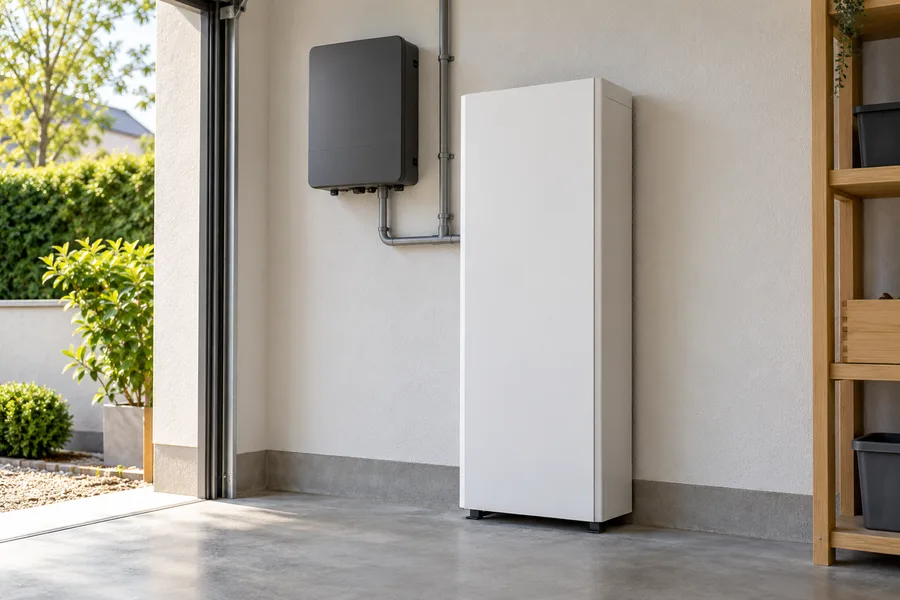
The right solar battery size depends on when your home needs electricity, how much surplus you can store and how quickly the system can charge or discharge. Start with those three questions before choosing a capacity from a catalogue. Annual electricity use and bedroom count alone cannot show whether a battery will be regularly useful.
Build an evening-to-morning energy budget
Use interval data from your meter or monitoring system where available. Separate consumption while solar can supply the home from demand after useful generation falls away. If you only have bills, begin a short usage diary and ask the installer which assumptions they will use to fill the gaps.
Here is an illustrative household budget, rather than a typical Northern Ireland home:
- Background use from 6 pm to 11 pm: 0.3 kW for five hours, or 1.5 kWh.
- Cooking above that background use: 1.2 kWh.
- One dishwasher cycle: 1 kWh.
- Overnight background use from 11 pm to 7 am: 0.15 kW for eight hours, or 1.2 kWh.
- Additional early-morning use: 0.6 kWh.
The total is 5.5 kWh. These entries are deliberately separate so the appliances are not counted twice. Your actual cooking habits, heating, overnight equipment and sunrise conditions could produce a very different result. The explanation of kW and kWh can help you translate readings into a budget.
Translate the budget into usable capacity
Check whether a quoted capacity is nominal or usable, and whether the usable figure already excludes the manufacturer’s protected minimum. Then ask what an additional backup reserve leaves available for normal operation. Do not subtract the same allowance twice.
For example, if a battery offers 6 kWh of usable stored energy and you keep 1 kWh of that for backup, 5 kWh remains for everyday use before delivery losses. That cannot supply the full 5.5 kWh budget above. It may still cover a worthwhile share; covering every unit is not automatically the most economical aim.
The Australian Government’s technical explanation of batteries distinguishes usable energy capacity from power output. Those technical principles apply here; its grants and local installation rules do not apply in Northern Ireland.
Check power separately from stored energy
Imagine a kettle drawing 3 kW, an oven drawing 2 kW and background demand of 0.3 kW at the same moment. Total demand is 5.3 kW. With no solar contribution, a battery limited to 3 kW continuous output would leave about 2.3 kW for the grid, even while it still held plenty of energy.
That brief import does not necessarily justify a larger system. Ask how frequently those overlaps occur, whether appliance timing could help and whether the proposed battery and inverter combination actually increases discharge power. Extra kWh alone does not establish that.
Can you fill it often enough?
Compare solar surplus after household use with the proposed capacity month by month. If a hypothetical day provides only 2 kWh of surplus, a larger battery cannot create the missing energy. If another day provides 9 kWh but you need only 5.5 kWh before the next sunny period, some extra capacity may go unused.
Charging power also matters. A system limited to 2 kW input can accept at most 6 kWh over three hours before losses and other limits. Ask whether a short solar peak or any permitted off-peak grid-charging window is long enough for the intended charge. Our grid-charged battery guide explains the separate tariff questions.
Compare the extra capacity on its own merits
Request two suitable sizes using identical household data and tariffs. Compare the additional installed cost with the additional annual energy delivered, rather than comparing capacity labels alone. Include the expected reserve, power limits and seasonal results. For an EV or heat pump planned later, model its timing explicitly and ask what expansion would require. The battery-sizing guide provides the specification questions to take into that discussion.
 Comparing Solar Quotes for Belfast and Across NI